Showing posts with label noncompete provisions. Show all posts

Monday, July 6, 2015

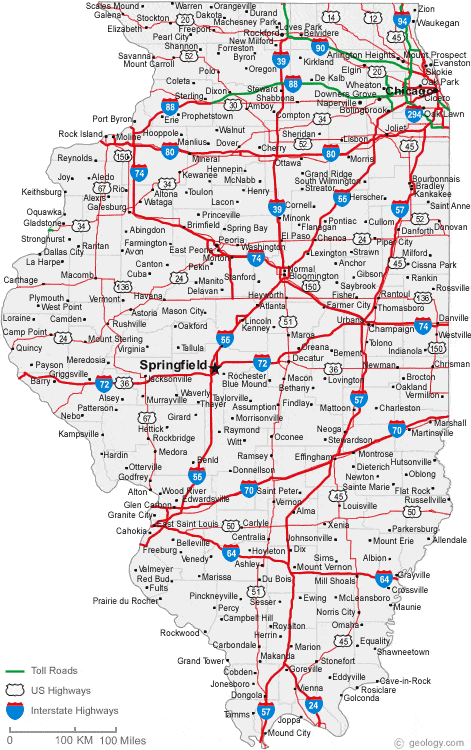
The Continuing Goofiness of Illinois Non-Compete Law


This is a terrific opinion by an Illinois intermediate appellate court that is well worth reading to get an understanding of the Grand Canyon-like fracture in Illinois noncompete agreements, and how courts are dealing with it.

The opinion lays out the application of what has recently been Illinois state courts' approach to the problem of adequate consideration for noncompete agreements, namely that an employee must be employed for at least two years after the effective date of the noncompete in order for there to be a valid contract.  The dissent, brilliantly in my opinion, reviews the entire history of this odd, bright line requirement, and notes the fact that federal courts in Illinois, with one notable exception, have consistently refused to enforce this two-year requirement.

Thus, the fracture. If you are an employee seeking to avoid the consequences of signing a noncompete agreement, and you haven't been employed for two years from the date of the agreement (and you didn't receive some other form of equivalent compensation to two years of employment), then you need to make a beeline for state court to file a claim for declaratory relief.  This type of claim allows the court to determine whether your noncompete is valid, and it's important that you, the employee, file before your employer figures out what's going on and files a breach of contract claim in federal court (assuming federal jurisdiction is available).  Illinois state courts will almost certainly enforce the two-year bright line test; if your employer can get to federal court first, then it will likely find a judge who will refuse to enforce the standard.

This is obviously intolerable.  But here in Illinois we specialize in working with the intolerable. There is a chance this divide will get fixed when the Seventh Circuit issues an opinion on a non-compete case later this year.  But there's also a chance the appeals court will kick the issue over to the Illinois Supreme Court for an advisory opinion, further delaying resolution.

In the meantime, non-compete clauses require some careful thought about enforcement.  I would tell employers to incorporate some type of declining bonus payout that erodes as the employee remains on the active rolls as consideration for any noncompete clause; if the employee leaves early, she gets a larger payout to support the non-compete agreement.  I think this will pass muster, based on this opinion, and others like it.

UPDATE:  While we wait for this all to sort out, here's a nice analysis of Illinois law regarding assessing the business interest protected by a non-compete, from the Seventh Circuit.

Tuesday, March 25, 2014

Saving Non-Competes with Forum Selection Clauses

I have been counseling a lot of clients on the use of non-compete agreements lately, and given our firm-centric focus in California, the issue often arises as to whether non-competes can ever be enforced for California employees.

Typically, the answer is “no”; California law categorically rejects any type of post-employment restriction on an employee's ability to seek work, even with a directly competing company. In addition, California courts historically reject employer efforts to get around the California non-compete rule by using a choice of law provision designating a non-compete friendly jurisdiction to hear any disputes. But a recent Supreme Court decision might be giving some life to the ability of out of state employers to enforce their non-compete provisions on their California work force.

The Supreme Court case held that contractual forum selection clauses should be enforced unless particularly unfair or exceptional circumstances exist. The ruling follows the trend already established in some California federal court cases. In one case, a Washington-based employer was permitted to enforce its Washington forum selection clause and choice of law provisions against California sales employees who left for a competitor. When the employer filed suit in Washington, pursuant to the selection clause, the employees tried to block the action by suing in California federal court. But the California federal court determined that the forum selection clause was valid. Other California federal courts have found forum selection clauses valid, for example in the case of a Pennsylvania company seeking to transfer non-compete cases from California to Pennsylvania. In both cases those courts ruled that the possibility that Pennsylvania law might be applied to the non-compete clauses was not a sufficient basis to void the forum selection clause in the employment agreements.  And a recent state court decision applying Pennsylvania law to a California resident employee is here.

So for non-California based employers, don’t give up hope with respect to your non-compete agreements. But you should start now, drafting provisions, in your employment agreements that contain forum selections clauses as well as choice of law provisions. The tide may be turning in a way that allows you to protect your business.

Tuesday, December 18, 2012

Arbitrating the Noncompete Case: The Supreme Court Speaks


The Supreme Court recently ruled that arbitration agreements in non-compete clauses are matters of federal law under the Federal Arbitration Act, notwithstanding the relatively transparent efforts by a state supreme court to deprive federal courts of jurisdiction.

The case arose out of the typical non-compete situation. Two former employees of Nitrolift, having previously signed an agreement with provisions containing confidentiality, noncompetition, and arbitration requirements, went to work for a competitor of Nitrolift. The former employer demanded arbitration in consonance with the terms of the non-compete provision, and the former employees filed suit in state court, asking the court to declare the non-competition agreements invalid. When the state trial court found the contracts arbitration clauses were valid and that an arbitrator was the proper fact finder to resolve the dispute, the former employees appealed to the Oklahoma Supreme Court. That court determined first that it had jurisdiction over the Federal Arbitration Act issue because there was a state statute in effect regarding covenants not to compete. The Oklahoma justices then found adequate and independent state grounds to justify assertion of jurisdiction.

Of course, these two initial findings by the Oklahoma court were simply an attempt to dodge the fact that it has no jurisdiction over these claims because it is a state court. And the U.S. Supreme Court stepped directly into that discussion by noting that the state court could only get jurisdiction by rejecting the federal act requirement that arbitrators should decide a contract's validity. In other words, there was a federal law basis present in the initial court decision, and the Oklahoma Supreme Court could not get around that federal basis.

So the U.S. Supreme Court gets the case, voids the Oklahoma determination, and then finds that the Federal Arbitration Act specifically holds that attacks on the validity of a contract, which are distinct from attacks on the validity of the arbitration clause, are to be resolved by the arbitrator and not a court.

While this was ultimately a win for the employer, and for proponents of arbitration, the lesson here is that non-compete, arbitration and non-confidentiality agreements should not be included in one  employment contract. State law varies dramatically on the enforceability of all three of these types of agreements and the confusion that was generated here (and the basis for state court mistakenly asserting jurisdiction) could have been avoided with better drafting. In other words, at a minimum, consider writing out separate employment contracts for confidentiality, non-compete provisions, and arbitration, especially if you are engaged in multistate operations.