Showing posts with label Protected Concerted activity. Show all posts

Monday, July 13, 2015

NLRB "Protected Activity" Foolishness Rejected by the DC Circuit


Two NLRB posts in a row, here, are a bit unusual, but the Board keeps making news. In this case, it's relatively good news for employers-the District of Columbia Court of Appeals has refused to enforce two separate Board rulings, both relating to the concept of "protected, concerted activity" that has provided the Board with a seemingly infinite basis to intervene in management decision-making.

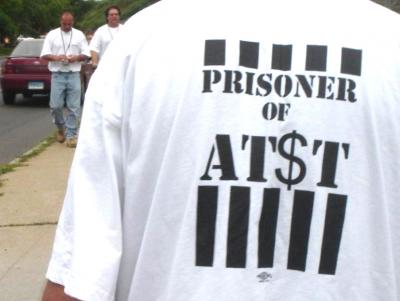
The first decision from the Court begins with an extraordinary assertion: "Common sense sometimes matters in resolving legal disputes." If only that were true more often.  The Court was reviewing a situation in which AT&T refused to allow its employees who interacted with customers or worked in public (this included employees who entered customers' homes on service calls) from wearing union shirts that said, "inmate" on the front and "Prisoner of AT$T" on the back.  The union, of course, was trying to make a point during contract negotiations with the company. As is frequently the case when unions reach out to engage the public in their negotiations, the conduct here was aimed, at least in part, at damaging the business's relationships with its customers.

AT&T instructed its employees who dealt with the public to remove the shirts, and when those employees refused, they received one-day suspensions. The union filed an unfair labor practice charge, and AT&T responded by arguing something called the "special circumstances" doctrine, which allows a company to ban pro-union messages on publicly visible apparel at work when the company reasonably believes the message may harm its relationship with its customers, or its public image. AT&T's position would appear to be commonsensical-nobody would want to have its employees entering customers' homes wearing shirts that said "inmate" or "prisoner".

The NLRB, however, refused to apply the doctrine, noting that no one thought the garb constituted prison wear, and therefore the company's concerns were overblown.  Yeah, right. This is a singularly narrow and misleading reading of the doctrine, in my opinion, since it ignores the obvious and intentional adverse impact of having people show up in customers' homes with this kind of message on their clothing.

The Court agreed. See the reference to common sense, above.  All an employer has to do is demonstrate a reasonable belief that the message can damage customer relations. That, AT&T was able to do, easily.


The second case involves an unbelievably long resolution time, but validates an important right for employers to control access to their property. In 1999 the Venetian, a luxury Vegas hotel and casino, was engaged in an organizing campaign with two unions.  The unions staged a major demonstration on Venetian property and the Venetian asked the local police to issue criminal citations to demonstrators for trespass.  After the unions filed unfair labor practice charges against the Venetian, the hotel argued that its request for police assistance was protected by the First Amendment-- specifically the petition principle that allows an employer to engage in conduct that would otherwise be illegal if the conduct is part of a direct petition to government for relief.

The board rejected the hotel's defense, but the Court of Appeals reversed, finding (and I don't think this is particularly controversial) that a direct petition to police for assistance falls under First Amendment protection. The Court remanded the case back to the Board to determine whether the request for police assistance was a valid one to secure property rights or whether it was a sham brought with the specific intent to further wrongful conduct through the use of governmental process.

The key for employers in this second case is to make sure that their conduct is focused on a judicially protected interest, that is, an interest that belongs specifically that the employer, before attempting to invoke this doctrine. Employers who, for example, report unionizing employees to the Department of Homeland Security for immigration purposes are not protecting their own interest. With that important caveat, the Court's guidance is clear and important, especially in union trespass situations.

Thursday, March 20, 2014

A Bad Attitude Policy and the NLRB


Most companies will terminate an employee for a lousy attitude that has tangible effects with co-workers and customers.  Sometimes that prohibition is expressed in an employment policy, most times it is not.  A recent NLRB decision dealing with the former situation should provide some solace to employers who seek to discipline employees that would rather be working somewhere else and don’t care who knows it.

The case concerned a restaurant that had a rule in its employee manual that prohibited insubordination or lack of respect and cooperation with fellow employees or guests, including “displaying a negative attitude that is disruptive” to staff and customers.  For some reason, the general counsel of the NLRB took the position that the rule clearly encompassed an area of protected concerted activity, in that employees would assume that the rule would prohibit them from being critical of the employer, which would inhibit the employees from raising controversial topics, including terms and conditions of employment.  Fortunately, the majority of the Board (in this case, the two Republican appointees) determined in fact that the relevant policy language limits the policy to unprotected conduct that would interfere with the legitimate business concerns of the restaurant.  In this case, "unprotected conduct" meaning being a butthead, specifically using an obscenity in front of the restaurant patrons, a "fit of pique [that] wasn’t part of the service that guests reasonably would expect".

The NLRB has been on the warpath against employment policies lately, taking a position that I can best express as, “if there is any possible way that a provision could be interpreted in a way that violates federal labor law, then the policy is illegal and must be voided.”  Fortunately, there are some more rational heads on the Board, and they prevailed in this case.

Wednesday, August 1, 2012

The End of Workplace Investigations As We Know Them?


Quite possibly, if a federal court upholds the latest NLRB opinion.

It is generally a caveat of an internal workplace investigation that participants in the investigation, whether they be victims, witnesses, or targets of the investigation, are not to discuss the matter under investigation or the investigation itself with their coworkers until the investigation is completed. The reasons for such a requirement are obvious: knowing that an investigation is in progress, and its focus, creates a very real prospect of witness accounts being altered, fabricated, or coerced, evidence being destroyed, or other steps taken to frustrate the employer's ability to get an accurate picture of what actually occurred.

But the NLRB finds that this routine instruction, which is often key in sensitive investigations such as those surrounding sexual harassment complaints, is a violation of the National Labor Relations Act. Specifically, a majority of the Board determined that prohibiting employees from discussing an ongoing investigation with their coworkers interfered with the employees' rights to engage in "protected, concerted activity".

As I have noted previously, federal employment agencies such as the EEOC and NLRB are working to eliminate general workplace rules by which management has functioned for decades. Instead, the agencies are forcing employers into specific, fact-finding exercises that must occur before any workplace policy is put into actual effect. Here, the Board required the employer to make a specific determination as to whether any given witness in the investigation needed protection, whether testimony was in danger of being fabricated, or whether there was a need to prevent a cover-up. Absent specific determinations by the employer (presumably reviewable by the Board with the benefit of perfect hindsight) that such danger was present, the "no discussion" rule was a violation.

Of course, it is frequently impossible to determine at the outset of an  investigation (when such instructions are typically given) whether there is a danger of a cover-up, witness fabrication, or other risks. Often by the time such a determination can be supported with actual evidence, it's too late because employees have modified their stories in response to the questions they know are coming, e-mails have disappeared, and employees have colluded on their version of events.

If this interpretation is upheld, it means that employers will have to make some type of record as to the various bases they have for keeping an investigation confidential, and the facts to support those bases.  The decision represents yet another highly intrusive move by the Board into the workplace of most US businesses.

Thursday, September 8, 2011

Social Media Update

In what should be no surprise, an NLRB administrative law judge found for a group of employees against their employer in the first fully litigated social media case under the National Labor Relations Act. The decision is, I hope on the outer edge of what the NLRB believes is sanctionable conduct, given that there was no attempt by the employees to raise any workplace issues with their employer. The conduct involved a group of employees complaining about coworkers and working conditions on Facebook. Several of the employees were terminated after the Facebook postings came to the attention of the employer.
The decision reinforces, again, the necessity for employers to avoid taking precipitous action based on social media conduct involving their workforce. See my post below for more details.

Monday, August 22, 2011

Social Media and the NLRB

Many employers who do not deal with unions on a daily basis are blissfully unaware that they can nonetheless find themselves in the crosshairs of the National Labor Relations Board for disciplining their employees. The most common way a nonunion employer violates the National Labor Relations Act is by disciplining employees for engaging in "protected concerted activity".
The NLRB's Office of General Counsel recently issued a lengthy memorandum summarizing its activities with respect to employees engaging in protected concerted activity using social media over the last year. The report is worth reading because it gives some insight into the Board's application of well-established precedent to a new and rapidly expanding medium--Internet-based social networking platforms such as Facebook, MySpace, and YouTube.
Most of the reported cases involve employees posting derogatory or negative comments about their working conditions on Facebook or other public access social media sites and then being disciplined for the posting by their employers. A couple of lessons from the NLRB case files:
1. The NLRB's reach into nonunion companies is expanding dramatically as a result of its focus on employer discipline for social media use. In fact, the Board is applying its standard rules -- that prohibit disciplining employees for discussing their terms and conditions of work with other employees -- to a new and vastly more expansive arena. What most of us would consider to be typical employee carping, which used to take place with a small group around the water cooler or coffee pot and simply did not last long enough to come to the attention of management, now makes its way out onto the permanent record of the Internet. Just as importantly, the involvement of other coworkers also becomes a matter of permanent record. When an employer responds to employee complaints about working conditions, business processes, or other conditions of work by disciplining those involved in the discussion, it's almost always going to run afoul of the NLRA.
2. Employers who try to protect themselves from Internet defamation by adopting broad policies prohibiting their employees from saying anything derogatory in their Internet postings are going to draw the wrath of the Board as well for creating overly broad, illegal work rules. Many of the cases cited in the outline are the result of the Board targeting a specific company policy containing broad or poorly defined prohibitions on social media comments.
3. Employers may, without fear of federal sanctions, discipline employees who post inappropriate or offensive matter unrelated to terms and conditions of employment or that do not involve or seek to involve other employees.
This NLRB is proving itself to be far more employee than business friendly. Smart management will review these cases and modify its policies and behavior so that it does not open the door to federal inquiry into its employment practices.